Sándor Csoóri’s Life
1930-2016
From Zámoly to Pápa
1930–1950
Sándor Csoóri was born on February 3, 1930, in Zámoly, into a Reformed farming family. His childhood was profoundly shaped by the world of the Hungarian countryside, the rhythms of rural life, the sustaining strength of community and the natural presence of folk culture. These early experiences would later become important sources of inspiration for his poetry, essays and reflections on society and community.
He attended primary school in his native village. Recognised for his talent, he was admitted to the Reformed College of Pápa in 1942 with the support of the National Institute for the Advancement of Rural Talent, graduating in 1950.
His childhood in Zámoly and his school years in Pápa brought together two formative worlds: his direct experience of Hungarian folk traditions and an expanding intellectual horizon encompassing literature, history and European culture.

The Young Student in Pápa

The Family Home in Zámoly
The Beginnings of a Literary Career
1950–1960
After graduating in Pápa, Sándor Csoóri moved to Budapest, where he began his studies at the Russian Institute of Eötvös Loránd University (ELTE). Illness forced him to interrupt his university education, but by then his attention had already turned decisively towards literature.
His first poems appeared in 1953. His early poetry was characterised by social sensitivity, a personal voice and a strong commitment to the fate of his community. His first collection of poems, Felröppen a madár, was published in 1954. That same year, his work was recognised with the József Attila Prize.
During the 1950s, he worked for the literary newspaper Irodalmi Újság and later became poetry editor of Új Hang. Following the Hungarian Revolution of 1956, he was excluded from the established literary institutions for a period, but continued to write. These years played an important role in his development, both as a poet and as an individual.


Poetry, Essays and Film
1960–1980
By the 1960s, Sándor Csoóri’s poetry had developed an increasingly distinctive and unmistakably individual character. In his poems, personal experiences and questions of collective destiny, images of nature and the fundamental concerns of human existence came together in a remarkable poetic unity. His rich metaphors, unexpected associations and passionate voice established him as a prominent figure in Hungarian poetry of the period.
At the same time, his work as an essayist began to flourish. His writings explored the transformation of Hungarian society, the fate of the rural world, the significance of folk poetry and folk art, and questions of national self-understanding. For him, folk culture was not a closed chapter of the past, but a living and continually renewable source of modern Hungarian culture.
He also developed close ties with the world of cinema. From 1968, he worked as a dramaturg at MAFILM, and through his creative collaborations became part of some of the most important artistic circles in Hungarian filmmaking. His literary and cinematic work shared a common purpose: the authentic portrayal of individual and collective destinies.

With his creative collaborators, Sándor Sára and Ferenc Kósa
Intellectual Freedom and National Self-Understanding
1970–1989
By the 1970s and 1980s, Sándor Csoóri had become an influential figure in Hungarian intellectual life. In his essays and public statements, he consistently addressed the condition of Hungarian society, questions of national self-understanding, the fate of Hungarian communities beyond the country’s borders, and the role of culture in sustaining a sense of community.
For him, belonging to a nation was not merely a historical or cultural circumstance, but also a matter of personal responsibility. In his thinking, the heritage of Hungarian folk culture, European intellectual traditions and the challenges of modern society were inseparably connected.
During the Kádár era, his writings and public activities repeatedly brought him into conflict with the political authorities. He was placed under surveillance, and his opportunities to publish were periodically restricted. Nevertheless, he continued his creative work and maintained his intellectual relationships.
During the 1980s, he became increasingly involved in shaping Hungarian opposition thought and dialogue. He attended the Monor Meeting in 1985 and was among the founders of the Hungarian Democratic Forum in 1987. For Csoóri, the question of democratic transition was closely linked to social self-understanding, cultural renewal and national responsibility.

At the home of Ferenc Novák (“Tata”)

At his home on Keleti Károly Street
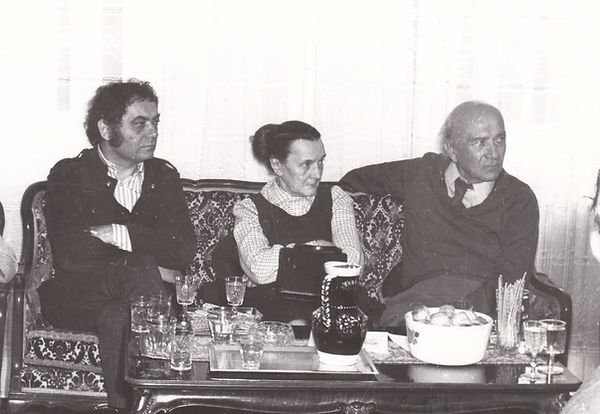
With Gyula Illyés and his wife, Flóra Kozmutza
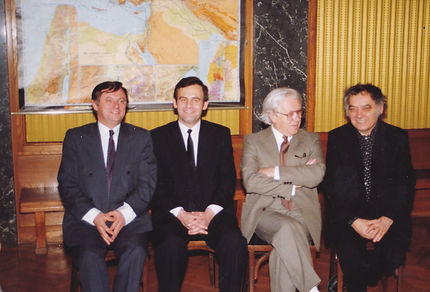
With Miklós Németh, László Tőkés and András Sütő

From the Democratic Transition to the Turn of the Millennium
1989–2000
The period of democratic transition marked a new chapter in Sándor Csoóri’s literary and public life. As one of the founders of the Hungarian Democratic Forum, he participated in the intellectual and political dialogue surrounding Hungary’s democratic transformation, while continuing to focus on Hungarian culture, national self-understanding and collective responsibility.
From 1988, he served as Chairman of the Editorial Board of Hitel, becoming its Editor-in-Chief in 1992. The journal provided an important forum for the discussion of literary, historical and social questions.
Between 1991 and 2000, he served as President of the World Federation of Hungarians. He devoted particular attention to the cultural connections of Hungarian communities beyond Hungary’s borders and to strengthening the intellectual bonds among Hungarians worldwide. He was also instrumental in initiating the establishment of Duna Television, which began broadcasting on Christmas Day in 1992.
Alongside his public activities, his poetry and essays remained an uninterrupted part of his creative life. Several important volumes appeared during this period, including Nappali hold, Hattyúkkal, ágyútűzben and Ha volna életem. His writings continued to bring together personal reflection, historical experience and a profound sense of responsibility towards his community.
With József Antall at the World Gathering of Hungarians, 1992
The Maturing of a Life's Work
2000–2016
In the years following the turn of the millennium, Sándor Csoóri increasingly devoted his attention to developing his poetic and essayistic oeuvre and reflecting upon his earlier experiences. Although he gradually withdrew from active public life, his writings continued to explore the questions that had defined his entire career: the fate of the Hungarian nation, national self-understanding, human freedom, and the relationship between art and community.
During this period, numerous new collections of poetry and essays were published, including Csöndes tériszony, Elkártyázott köpeny, Futás a ködben, A pokol könyöklőjén and Már én se volnék harminc év. His later poetry placed particular emphasis on personal reflection, remembrance and confronting the passage of time and mortality.
His achievements continued to receive major recognition. He was awarded the Prima Primissima Prize in 2008, the Kossuth Grand Prize in 2012, and the title of Artist of the Nation in 2014.
He lived a largely private life during his final years. His 85th birthday was celebrated at the Petőfi Literary Museum in February 2015, marking one of his last public appearances.
Sándor Csoóri passed away on September 12, 2016, at the age of 86. He was laid to rest at Óbuda Cemetery in Budapest.


Awards and Honours
Recognition of Sándor Csoóri’s literary, artistic and public achievements
1954, 1970 - József Attila Prize
1978, 1990 - Alföld Prize
1981 - Herder Prize
1984 - Bibó István Prize
1985, 1995, 2004 - Book of the Year Award
1987 - Déry Tibor Prize
1989 - Fitz József Book Prize
1990 - Kossuth Prize
1990 - Magvető Publishing House Award of Excellence
1990 - Radnóti Prize
1995 - Eeva Joenpelto Prize
1997 - Károli Gáspár Prize
1997, 2005 - Hungarian Heritage Award
2000 - Commander’s Cross with Star of the Order of Merit of the Republic of Hungary
2000 - Kölcsey Memorial Plaque
2003 - Arany János Grand Prize
2004 - Hungarian Art Award
2004 - Hungarian Freedom Award
2006 - Balassi Bálint Memorial Sword
2007 - Győr Book Salon Literary Award
2008 - Prima Primissima Prize
2012 - Kossuth Grand Prize
2013 - Grand Prize of the Hungarian Academy of Arts
2014 - Honorary Citizen of Budapest
2014 - Artist of the Nation
2015 - Honorary Citizen of Esztergom
Kossuth Grand Prize · 2012
Grand Prize of the Hungarian Academy of Arts · 2013
Artist of the Nation · 2014